
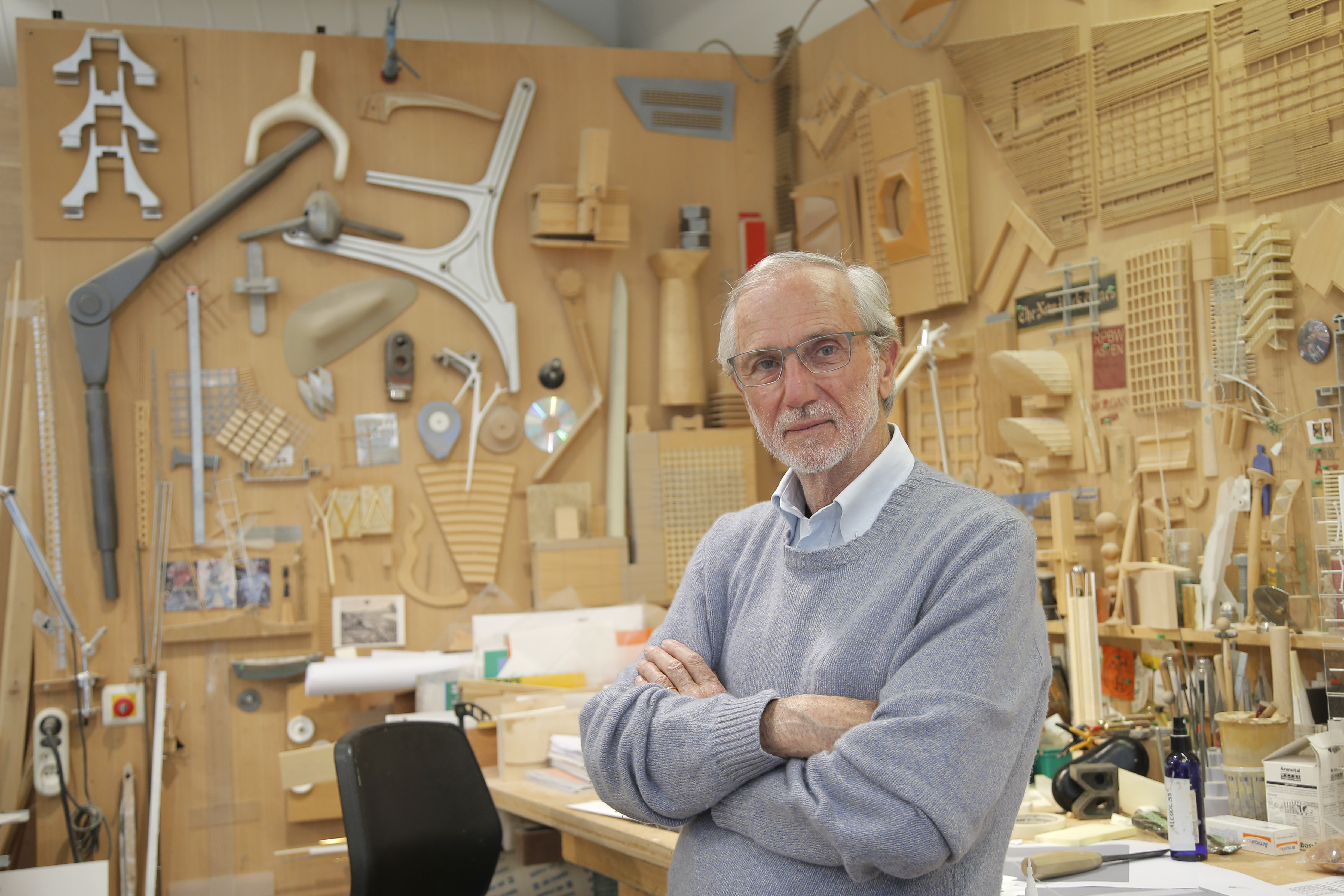
The Royal Academy provides an architectural feast with their current exhibition, Renzo Piano: The Art of Making Buildings.
Few people know this, but the early designs for the Grafton Centre, bordering East Road in Cambridge, were worked on by Renzo Piano. The development was caught up in the caustic and acrimonious local politics of the 1970s and in the 1980s the City of Cambridge ended up with a lumpy yellow brick building rather than a design by an innovative young architect. The City, aside from the buildings of the University and Colleges, is woefully short of interesting architecture but somewhere in the Council archive must exist Piano’s preliminary drawings, intending to bring life to this then – and now – rundown area: a poignant and missed opportunity.
Fast forward to 2018, there are few with a critical eye who have not marvelled at Piano’s most significant building in London, the Shard. The London skyline has altered much since WW2 but the Shard changed it at a stroke, moving the eye away from the City to South of the River. The building has invigorated an area, best known for its notoriety since the Middle Ages, and transformed it into a thriving commercial, cultural, gastronomic and residential hub. Love it or hate it, view the Shard from the east side of Waterloo Bridge and its eight angled panels are elegant, fragile and weightless; get close up and its enormity and strength takes your breath away.

Renzo Piano was born in Genoa in 1937 to a family of builders – structure was in his DNA. After studying and teaching in Milan he joined forces with Richard Rogers to form an architectural partnership in London. One of their early projects was the Centre Pompidou in Paris – a gallery designed to display French art of the C20th – surprisingly without a home at the time. Won by competition, to the amazement of the profession, this was the breakthrough building for both architects. Emphasised by lightweight steel construction and natural lighting through large walls of glass, the structure was turned inside out. Thus, the building’s interior spaces were without interior supports allowing for wide and open display spaces. The building was innovative at the time and looks as contemporary today as it did when it opened in 1977.

Over the next 40+ years Renzo Piano has continued to break down architectural barriers. The best of his work continues to combine lightweight engineering and experimental joining of materials together with a sense of social purpose. Unlike some of his contemporaries, he avoids a signature style; buildings by Frank Gehry and Daniel Libeskind are immediately recognisable but Renzo Piano regards style as restraining:
‘Making buildings is a civic gesture and social responsibility. I believe passionately that architecture is about making a place for people to come together and share values’.
This ethical side to Piano’s practise is evinced in his latest commission to oversee the re-construction of the Ponte Morandi, the viaduct in Genoa crossing the Polcevera river, which collapsed in August 2018 crushing vehicles and buildings underneath. The design, which he has provided for free, shows the road sitting on pillars, each resembling the prow of a ship with tall posts illuminating the bridge at night in the shape of sails representing the 43 victims of the disaster.

The exhibition at the Royal Academy is presented, firstly, in two of the Gabrielle Jungels-Winkler Galleries on Burlington Gardens, which is newly renovated with beautiful natural light streaming through contemporary clerestory windows. Here is an overview of the architect’s practice through sixteen of his most significant projects, all exhibited on white and natural wood tables with displays of models, plans, drawings, contemporaneous notes and explanatory labels; some of his most recent projects are displayed together with earlier works and his on-going experimentation with structural systems. Larger models and mock-ups hang from the ceiling highlighting the displays at each table with structural and sculptural forms. Each table represents a model of individual projects – museums, an airport, a hospital and a newspaper headquarters – widely dispersed between New York, Los Angeles, Houston, San Francisco, Paris, Santander, Nouméa in New Caledonia and Entebbe in Uganda. This is not an exhibition for casual viewing – canvas and wood directors’ chairs are available for serious contemplation.
The largest and most innovative surprise is kept to the third, darkened room. The centrepiece is a cedar model of an imaginary island, whose undulating landscape is covered with over 100 scale models of Piano’s works – reminiscent of the display of the fortified French towns in the basement of the Palais des Beaux-Arts in Lille. The variety of Renzo Piano’s projects are here writ large – in over 50 years in practice he has proved he can be creative and original whatever the project – and at the age of 81 he’s still working every day with a notebook, since he likes but distrusts computers!

The Royal Academy is no stranger itself to architectural themes in 2018. It celebrates its 250 anniversary with a long promised revamp. Visitors can now drift through the existing courtyard entrance at Burlington House in Piccadilly in a straight line to Burlington Gardens at the rear. The architect David Chipperfield has unlocked and revamped the most significant expansion in the RA’s history. The footprint is increased by 70%, new galleries have been added showing the RA’s own distinguished collections together with a new lecture theatre, increased education space and opening up, for the first time to public view, the area which houses the distinguished RA Schools.

In addition, if you enter Burlington House from Piccadilly in the courtyard you will be surprised to see a scaled down house – not to be confused with Renzo Piano’s work. It is, in fact, Cornelia Parker’s ‘Transitional Object (PsychoBarn)‘. Standing at nearly 30 feet tall, the structure is composed of a scaled down traditional American red barn. You may recognise the property; it’s based on the Bates’ family motel, memorably depicted in Alfred Hitchcock’s 1960 film ‘Psycho’ – spooky.
Renzo Piano: The Art of Making Buildings will be shown at the Royal Academy until 20 January 2019. For more information, click here.
The exhibition was organised by the Royal Academy of Arts, London, in collaboration with the Renzo Piano Building Workshop and the Fondazione Renzo Piano.


