

Emily Walters’ collage, Baroque Carnival Euphoria, is a gorgeously frothy pink concoction that celebrates the extravagance of Italian frescoes and the Carnivale di Venezia whilst also looking forward to contemporary neon street art and pop culture.
Camp taste turns its back on the good-bad axis of ordinary aesthetic judgement. Camp doesn’t reverse things. It doesn’t argue that the good is bad, or the bad is good. What it does is to offer for art and for life a different – or supplementary – set of standards.
Susan Sontag
As a notoriously and gloriously elusive aesthetic, the baroque has always had a rebellious edge. Once a pejorative description, akin to kitsch, the baroque can be seen to question the absurdity of severing art and life into categories of ‘garish’ and ‘subtle’, ‘tasteful’ and ‘tasteless’, ‘superficial’ and ‘multifarious.’
In eighteenth century Venice, the Baroque Carnival unashamedly swirled together such polarities – at once advocating for decadence, indulgence and delight, whilst also having the practical, political function of seeking to preserve the city’s prestige. During Carnival, rigid hierarchies and segregatory power structures were effaced. Sumptuary laws were suspended, whilst extravagant masks afforded anonymity and engendered debauchery. The liminal space of the carnival, along with the freedom from impositions and expectations that it enabled, must have been uniquely euphoric.

In many ways, collage is an ideal medium to explore the kaleidoscopic quality of the baroque; expressing its dazzling timelessness and enacting its propensity to reclaim and reframe. Baroque Carnival Euphoria recalls the extravagance of classical frescoes, whilst foregrounding the aesthetic’s contemporary pop-culture revival by juxtaposing marble sculptures with neon street art and hand-written embellishments. A layer of fluorescent, sprawling line-drawn faces offers a modern re-imagining of the Venetian masks of the past, evoking the baroque as a celebratory space of unconfined exuberance. These bright outlines further allude to the prevalence of a very different kind of mask in our present world, along with varying associations of protection, freedom and restriction. Crucially, the sugary pink background is defiantly flamboyant and camp. Above all, Baroque Carnival Euphoria is serious about being frivolous.
About Emily Walters
Emily Walters is a linguist, writer and illustrator. Having completed an MA in Visual Culture at Durham University, she is now a co-founder and editor at MEDUSA, a creative collective exploring art & culture through a feminist lens. Much of her writing focuses on identity, activism and connection. Follow Emily on Twitter @emilywalters_ and on Instagram @emilygracewalters
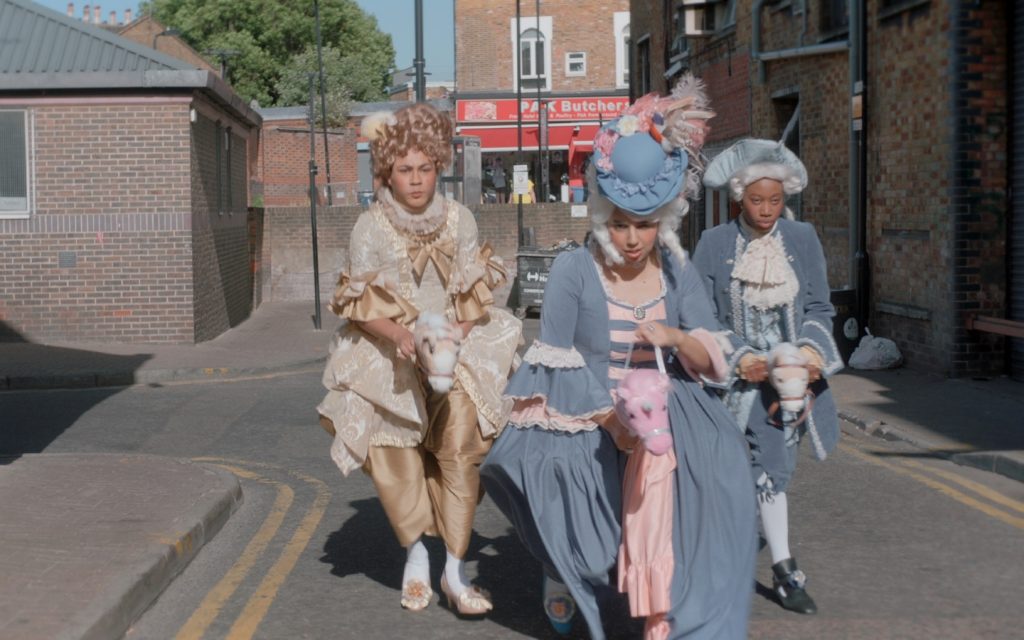
This piece was commissioned for our latest guest editorial, BAROQUE
The ‘baroque’ is an intemperate aesthetic. Once a period term to describe the visual arts produced in the seventeenth century, its use and significance has exploded over the last fifty years. No longer restricted to the fine arts, the baroque has fallen into pop culture and become an icon.
Inspired by the work of Shola von Reinhold, this series takes ephemera and excess as its starting point for a new exploration of the b a r o q u e. It wants to look back at the past and queerly experiment with it, to rip it up and reclaim a new space for the future – or, in von Reinhold’s words, ‘to crave a paradise knit out of visions of the past’. The b a r o q u e is present in moments of sheer maximalism, in ornament, frill and artifice. It celebrates the seemingly bizarre and the unintelligible, the redundant and fantastical. Disorienting and overwhelming, it offers a decadent way of experiencing present and past worlds.
Click here to see the full Call Out and submit to b a r o q u e, Guest Edited by Frankie Dytor.


