

From influencers promoting the latest wellness fad to the ‘messy heroine’ trope of recent hit TV shows, the concept of authenticity has never been more widely preached, obsessed over and marketed writes Lisa Goodrum in her review of Emily Bootle’s persuasive new book, This Is Not Who I Am.
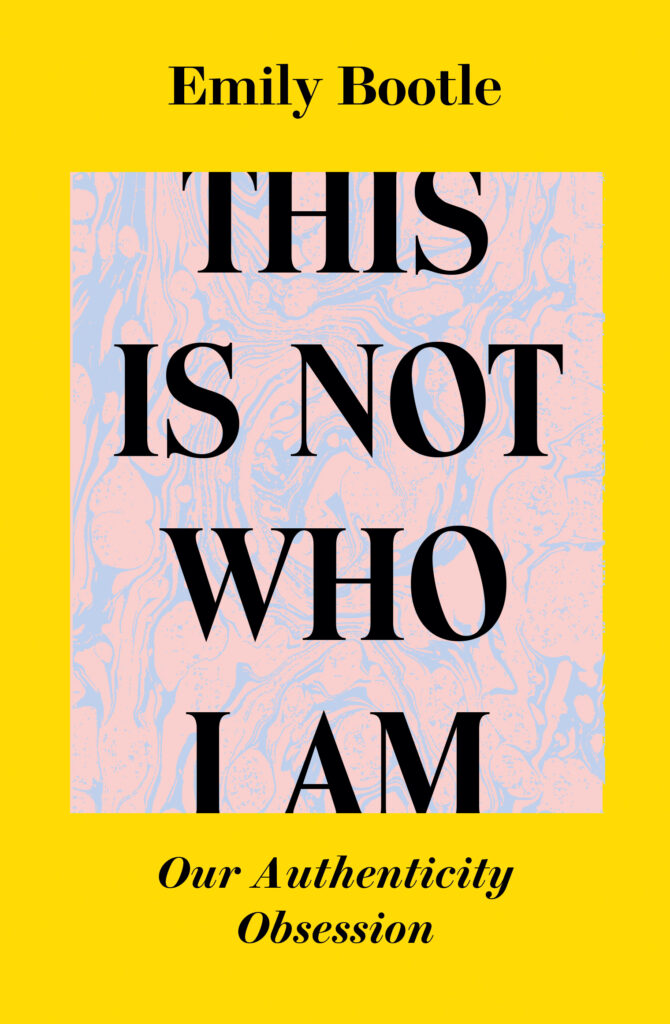
As the promise of a new year has elided into spring, some of us are still tenaciously clinging to our resolutions whilst others jettisoned them when cold weather prompted a night in front of Netflix rather than a gym session. The annual promise of a ‘new year new you’ is rooted in the belief that inside all of us lurks our real self. This entity is our ‘authentic’ self, our purest essence, and we appear to be in a continuous quest to find it. In This Is Not Who I Am: Our Authenticity Obsession (Ortac Press), Emily Bootle deftly examines how we are bombarded by the injunction to be ‘authentic’ and how this mandate has slithered across the online discourse surrounding wellness and mental health. By carefully dissecting our influencer-dominated media, she considers the commodification of authenticity and analyses how its rhetoric is used to sell us more products: from artisan bread to ethically sourced designer handbags and ‘clean’ food. Such purchases elevate a discerning customer above the conformist masses and perpetuate the individualism by which consumerism, and its new best friend, authenticity, are fuelled.
Nowhere is the dance between individualism, authenticity and consumption more complex than in the figure of the influencer who, with their perpetual posts of honed bodies, exotic holidays and celebrity partners have rendered their seemingly idyllic lives aspirational. Bursting onto the social media scene in the 2010s, the influencer is a human marketing tool who recommends particular items and services to their large social media following. Bootle adroitly describes them as ‘not only ambassadors for brands and products: they are themselves brands and products’ so that as the dancer becomes the dance, the influencer becomes the product, and they create an ambiguous digital realm where the boundaries between aspiration and actuality become ever more blurred. This liminal space is largely populated by attractive young women who span the fields of beauty, fitness and lifestyle: all pillars of the beauty industrial complex to which women are chained. Globally, personalities like Chiara Ferragni and Kayla Itsines hold considerable online sway whilst in a British context, Molly Mae Hague, who has 7.4 million Instagram followers, was appointed Creative Director of the fast fashion retailer Pretty Little Thing, proving that the ‘brand’ and the ‘product’ constitute a Gordian knot that has social media in an uncompromising grip.
Within these confines, authenticity becomes complicated. It exists precariously on the edge of ideas about purity and truth, terms that both possess a moral value. ‘Pure’ and ‘true’ are deceptive words that have historically enjoyed the power to dominate and control, especially women’s behaviour. The notion of a ‘pure’ woman still exerts a pernicious stranglehold on our perception of her value. In a perceptive observation, Bootle contends that it is no coincidence that these ideals inflected the ‘wellness’ craze, the advent of clean eating and the preponderance of – largely women – health and wellbeing gurus online. Such phenomena sprung from our inherent belief that to become authentic we had to embark on a process of purification. In the early twenty-first century, such rites included eating a plant-based diet, practising Pilates and inserting jade eggs into the vagina, the latter recommended by the doyenne of wellness, Gwyneth Paltrow, who has been described as a ‘walking, talking wellness corporation.’ Across platforms like Instagram and TikTok, images of quinoa salad and avocadoes were rampant and accompanied by trenchant advocacy for juice cleanses and methods for losing body fat. The zealotry with which wellness was promoted online ensured its cult-like status and the conviction of its disciples that physical purification engenders a new and better self. Such cleansing is expensive however, and Bootle is at pains to identify wellness as the preserve of the affluent and time rich. It is ‘shiny’ and ‘wealthy’ and inculcates the belief that the amount of money we spend on wellness directly correlates to the glossiness of our authentic self. We then reveal this new, improved self in an online hyperreality that usually fails to acknowledge the messiness of our quest.
The road to authenticity is a struggle, and it has been deliberately marketed as such. The endeavour has been bestowed with a pious quality complete with self-flagellation, such as the pain of boutique exercise classes like Soul Cycle. There, participants ride a stationary bike in a dimly lit studio accompanied by energising music and evangelical instructors. These classes are an almost religious experience for the attendees and have a confessional air. Students have described crying and experiencing an emotional shift that leaves them feeling lighter and brighter. The concept of exercise as atonement is now firmly established in the zeitgeist and mirrors how important therapeutic emotional release has become for our culture. For Bootle, the therapy session enjoys the same significance as ritualistic confession. In our previously religious society, or in one dominated by the Roman Catholic Church and the obligation to seek forgiveness before receiving Holy Communion, confession was integral to a citizen’s life. In secular societies however, our reliance upon literal confession, and religion itself, has significantly dwindled.
Confession is now physical purification or emotional catharsis, and the latter has come to provide a space where women creatives can find shelter. The impulse to reveal their deepest and darkest secrets and most embarrassing moments appears to unite women writers, artists and musicians, and has fuelled a debate that clouds their creativity: do women have to expose their most private thoughts and feelings in order to be taken seriously as cultural producers? Can we only find value in a woman’s work when we know that she has exposed her most intimate thoughts and relived her most personal moments? A recent spate of memoirs such as I’m Glad My Mother Died by Jeanette McCurdy, How to Murder Your Life by Cat Marnell and Strong Female Character by Fern Brady epitomise an ironic interrelationship in which women creatives receive more recognition when they expose the rawest and ugliest parts of their lives. This phenomenon connects to what Bootle calls the rise of the ‘messy heroine’ and whilst I have provided literary examples, she focuses on their televisual counterparts. Characters like Fleabag and Arabella in I May Destroy You are profoundly flawed, confused, and at times, highly unlikeable but it is precisely the revelation of their authentic and convoluted selves that has endeared viewers to them. These characters are the antithesis of influencer perfection and despite their fictionality, by allowing audiences to witness their vulnerability, they expose a kind of reality that is firmly rooted in the ‘real’.
For Bootle, this eradication of artifice is akin to the self-excavation one undergoes in therapy. The messy heroine or messy creative may well experience a gleeful catharsis in unburdening themselves but today we all seek such expurgation in the therapist’s office. The assumption that we can only arrive at enlightened authenticity by working on ourselves has become a cultural tenet. In an arch and knowing tone that could easily be accompanied by a wink, Bootle notes the ubiquity of the phrase ‘my therapist says’ and how those who do not engage in the practice are viewed with suspicion, if not outright disdain. It is accepted that only those who undergo therapy will discover their authentic selves, whilst the wellness and self-help industry that has emerged in tandem with this sentiment has only consolidated the conviction.
Our culture’s therapization is complete to the extent that therapy speak is part of our common vernacular. It is normal to refer to ourselves as ‘triggered’ or discuss our desire to ‘raise our vibration’ and live authentically. We are supported in these endeavours by the podcasting and publishing industries who produce content like Best Friend Therapy, Happy Place and We Can Do Hard Things, whilst books like Authentic: How to Be Yourself and Why It Matters and The Power of You: How to Live Your Authentic, Exciting, Joy-filled Life Now! stress the importance of authenticity to living a bigger and better life. In this climate, authenticity is not merely a privilege: it is an obligation. Modern society presents being authentic as a task incumbent upon us. As we feel compelled to attend Barry’s Boot Camp or drink green juices to physically improve ourselves, we are bound to perform the mental and emotional equivalent. To be an active and responsible citizen, we must whittle away our metaphorical flab to present a honed and varnished version of ourselves to the world. Yet, our journey to authenticity cannot only be conducted internally. Authenticity is dependent on an audience, preferably digital, to bear witness to and validate it. As Bootle so skilfully captures, our authenticity obsession is a convoluted and counterintuitive corollary of our desire to be seen.
Emily Bootle’s This Is Not who I Am: Our Authenticity Obsession is published by Ortac Press and is available to purchase online and in all good bookshops now.


