
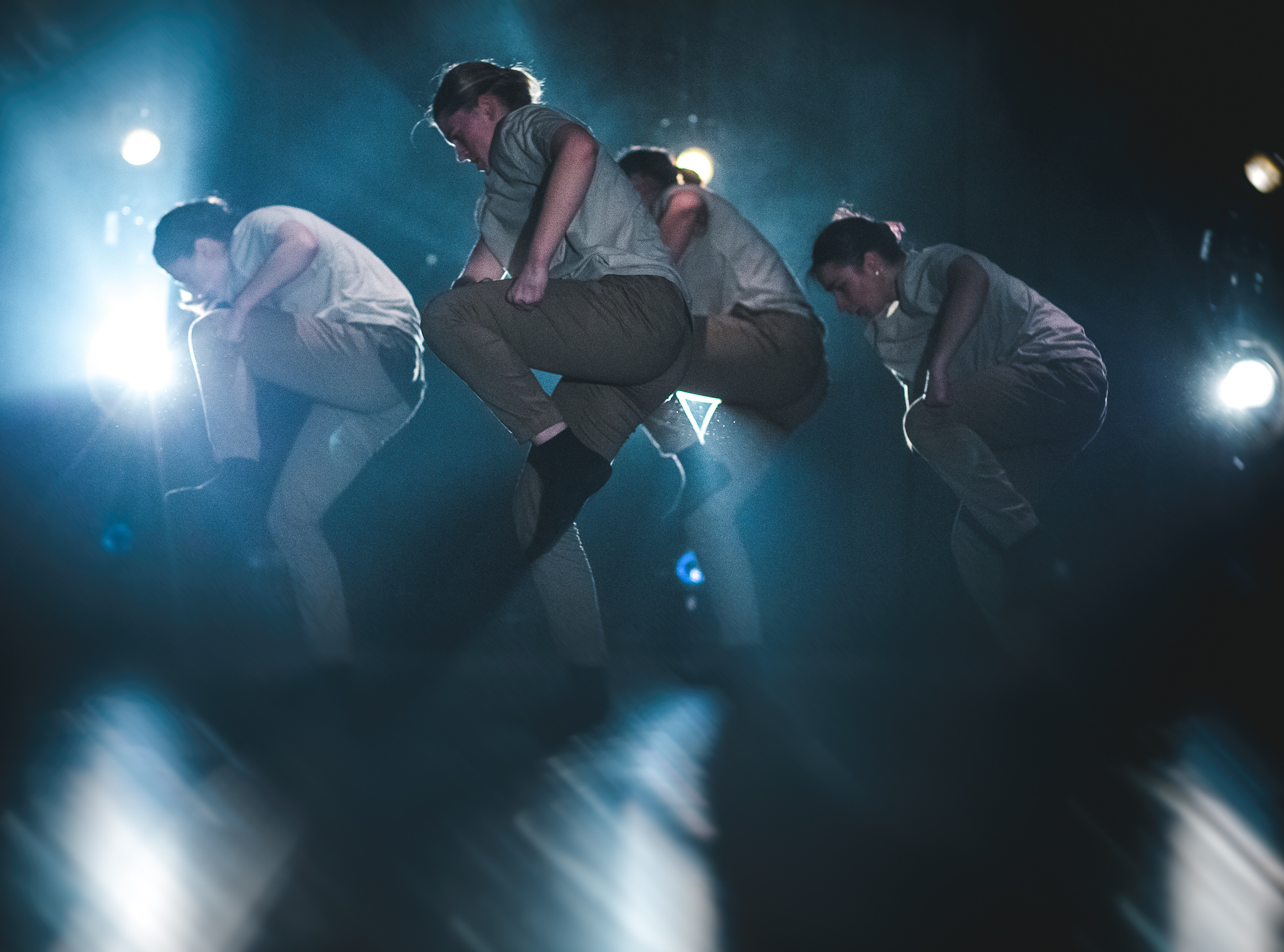
Shirley Ahura reflects on the physical and social pressures placed on today’s dancers after seeing Christina Dionysopoulou’s exceptional piece, Catch 28, at The Place.
As a dancer, you are often faced with two options: hyper-visibility on the one hand, or be rendered wholly invisible on the other. The world of dance is largely an insular one, arguably more so than any of its other performing arts relatives. Part of the reason for this stems from a somewhat inconsistent fact that even though dance is a thriving industry in the UK, resources within the profession are finite. At best this results in fewer opportunities. At worst, it fosters exploitative working environments, back-door nepotism, crab-in-the-barrel politics, fewer options to unionise, and a consequently low regard for workers’ rights and well-being.
The dance community is also a small, inward-facing one. It’s unsurprising then how completely plausible it is for any given person to know what any given dancer is working on at any given time: what you are rehearsing for, which agency is representing you, who has been booked on what job, paid or unpaid, and by whom – you name it, we know it. Add to the melee, the wonders of the digital age. The prevalence of social media merely compounds this access. The inconvenient truth that platforms such as Instagram (also known as the holy grail of viral dance fame) essentially double up as digital CVs for most professional dancers to self-promote, shows just how difficult it is to navigate the industry without forcefully putting yourself front and centre stage.
External and almost antithetical to this is how marginal a space dancers take up in the public sphere. In the chain of being of the entertainment world, dancers are categorically the least paid group; they’re paid a lot less than management and production teams, technical crews and even backing singers. Exacerbating this is the hierarchy of art forms implicit in the dance realm. Those coming from more widely recognised and respected formal training backgrounds generally enjoy more exposure, access to opportunities and long-term success. The truth is a simple one: styles spanning the high-brow, high-art spectrum – from Russia’s classical ballet to modern European and contemporary dance – fare much better in the mainstream, for instance, than the Hip Hop and street dance genres birthed in the inner-city neighborhoods of California and New York.
Self-doubt lurks at every corner. Plaguing the psyche even more than this is an incessant drive to push our beleaguered bodies way beyond their limits
In the private realm meanwhile, dancers withstand extreme pressures internally. Physical strain and overexertion are commonplace conditions. So too are the psychological pressures that accompany the training you do, the choreography you make, as well as the heights in your professional career that you are able to attain. You are simultaneously trying to be the best version of yourself whilst remaining conscious of the prescriptive industry standards of ‘look’ and body image, and yet somehow within this having to constantly configure ways to stand out from the crowd. Self-doubt lurks at every corner. Plaguing the psyche even more than this is an incessant drive to push our beleaguered bodies way beyond their limits.
It is at this intersection that we find Christina Dionysopoulou’s Catch 28, a personal reflection on the coping mechanisms used when societal expectations affect being a dance artist. Catch 28 is as much storytelling through movement as it is a work of art. In this piece, an introspective all-female quartet delve into the themes of isolation, guilt and courage vis-a-vis inner anguish and outer conflicts.
The dancers move together across the stage as a unit, in sync to the very core…Alone they are absorbed in their struggles. Together they are impenetrable.
Opening with a dark and brooding tone, the four dancers appear in the far right corner of the stage, facing away from the audience. Their heads are down and only their backs are visible. For reasons yet unknown, there is a wilful disengagement established from the outset – an unspoken request on the part of the performer that the spectator be kept at bay. This attempt to distance becomes more acute as our four dancers descend into a chaotic and tortuous journey of anguish and bitter inner conflict. The choreography is seemingly borne out of frustration, even anger. Far from being directed at anyone in particular, this anger appears to come solely from within. What becomes clear is that anger is something channeled by, through and within the individual. In the presence of a dancing quartet, this process is proliferated four times over. The dancers move together across the stage as a unit, in sync to the very core. With every transition, the affliction spreads like wildfire. Each individual carries and incubates her own inner conflict; a testament to the solitude a dancer can feel in an industry that is unforgiving. Alone they are absorbed in their struggles. Together they are impenetrable.

In Catch 28, the dancer’s body is the site of contestation. We see the performers repeatedly hitting different parts of their bodies; balling their fists, they pound into their chests, stomachs, legs and thighs over and over again in set sequences. Embodied in these repetitive movements is the self-criticism that they all appear to be working through. The balled fists become more frequent, the blows become more belligerent. The performers wound and injure themselves almost into submission, as if making a perverse attempt to manipulate and re-mould their bodies under the scrutiny of industry expectations. This clear leitmotif that runs throughout the piece symbolises just how tough dancers can be on themselves in the quest for perfection. As documented in BBC 4’s compelling documentary Danceworks early last year, which follows the lives of four professional dancers from different disciplines, the quest for perfection demarcates a fine line between artistry and obsession. In Dionysopoulou’s piece, self-deprecation, self-doubt and, in some cases, borderline self-harm are the natural conditions of the dancer-athlete. Perfection necessarily entails sacrifice, a sacrifice that the performers in Catch 28 are all too familiar with.
The segment reaches its climax in one of the most memorable moments of the piece. The music cuts and the dancers pause in the silence that follows. They are breathing heavily, gasping both for air and reprieve. It’s audible enough for the audience to sense that the pressure placed on their bruised and battered bodies has truly taken its toll. On their faces is a look of pure disappointment. A revelatory moment transpires, the Catch-22 here being that even after all the physical and mental toil, has anything really been achieved?

After a deluge of rejection, negativity, criticism and doubt, rebuilding is the only remedy for the Self. In the segment that follows, the quartet proceed to lay the foundations towards this reconstruction, as each dancer finds healing in her own way. Balled fists replace helping hands, as the performers quite literally lift their bodies out of the mire of previous failures in ways that are no longer abusive, but constructive. The stage is gradually flooded with light and the music becomes both upbeat and uplifting. Through collective sounds of affirmation and encouragement, they begin to create their own musicality, dancing to rhythms of their own making. The scene is a truly moving one, as the audience bear witness to the performers’ rediscovery of themselves on their own terms. Galvanized together in this way, they are a force field offsetting both the external pressures and inner conflicts that threaten to impose on their shared identity as dancers. The journey of frustration and self-doubt can seem cyclical, but in reality is impermanent. As we see in the breakthrough moment of the finale, all four dancers finish the piece facing upwards for the first time during the performance – a sure sign that there is hope for all who are willing to do the restorative work.

In Catch 28 , the journey that the dancer-athlete undergoes is far from painless. The growth obtained from pushing one’s mental and physical abilities to the limit is like the growth of a single thorned rose: as breathtaking as it is noxious. The triumph of Catch 28 lies both in the exceptional performances of its all-female cast, as well as in Christina Dionysopoulou’s vision. Boundary-breaking and inspired, Catch 28 is a testament to the imaginative work of women emboldened not in portrayals of grace and beauty alone, but also in exemplary positions of strength, athleticism and power.
Christina Dionysopoulou’s Catch 28 was performed at The Place as part of their Resolution 2019 Festival of New Choreography. Click on the links for more information regarding this performance, Resolution 2019 Festival and Christina Dionysopoulou.


