

In her latest work of creative non-fiction, award-winning author Irenosen Okojie explores the rich legacy of hope and life handed down through her mother and grandmother. In hauntingly beautiful prose, Okojie reflects on how past events can offer light and healing in present times of difficulty.
Three Wise Women
By Irenosen Okojie
That period I call winter, when life seemed unbearable and I found myself crying silently on peripheries slightly beyond the city, I thought about being unwittingly complicit in the disappearance of a woman I used to know. Who looked just like me. What I had left were her excavated bones, which I was forcing myself to survey in order to kick-start my own resurrection.
My mother used to tell me the story of how I’d nearly died as a baby. She would always mention this anecdote randomly, uncannily, whenever I was in good spirits as if to remind me to appreciate the chance I’d been given and to warn me of dangers lurking around corners. I’d suffered from frequent convulsions as a baby. Nobody knew what caused them but they greatly concerned my mother and occasionally terrified her. In one instance, I convulsed so badly I became unusually still, dead-eyed, quiet. My mother tried everything to revive me but nothing seemed to work. It had been an unbearably hot afternoon, she said, and in the evening, the moon appeared even more beautiful than usual, as if mocking her worry.
This was in Benin, Nigeria. We were staying in the rural parts and the nearest hospital was at least a two-hour drive away. My father was out of the country on a business trip. There was no time. Panicked, a little out of her mind, my mother took me to her mother, who tied me on her back and carried me into my uncle’s car, a temperamental white Volks-wagen Beetle. They drove to the local river, rushing down the long road until they got to the banks, where they waded into the water with me, and my grandmother reached under the surface and fed me something, some weed or part of a plant, which saved me. Many years later, when winter arrived and sucked me into its bleak depths, I thought about that image a lot: three generations of women in the water at night; an intervention, the moon as a witness.
Now that grandmother was gone. My mother had her own worries. The first few days of my winter, the start of a long period with no seasonal change, I became obsessed with finding out what my grandmother had fed me to revive me. I was fixated on that small detail. I sat in train carriages watching for a far-flung white calla lily to manifest from a rip in a seat; I wandered through museums hoping for African seaweed to spill out of my pockets; I loitered in the waiting room of my local GP longing to catch some wayward water creature through the rhythm in my chest, a creature my grandmother had sent to me from beyond the grave that had only moments left to breathe in the cloistered air of the surgery. But my grandmother had taken her secret with her, and having lived away in England since I was eight, I never thought to ask; the folly of youth. Not even my mother knew. This devastated me as a succession of traumas over the previous years had cast me into a broken place, a seemingly immovable purgatory.
Despite all my efforts to remain optimistic, I was sick. I felt hollowed out, as if my entrails were floating above the city, waiting for someone to hold them. I battled a terrible lethargy, couldn’t sleep, my back hurt from stress and pressure. A searing pain shot through my chest whenever I stepped outside. A cycle of negative thoughts spun on a loop in my head and I couldn’t take in the beauty of anything. The frenetic pace of living in London made it hard to pause, to appreciate the glorious light between women passing in animated conversations, the knowing gaze of a fox tailing me at night when I circled our area for a rush of cold air, the poetry of untied shoes in park trees.
I ran. I walked the dog every day. I attended a Buddhist meeting with a friend – an illuminating experience filled with angry, anarchic Buddhists arguing and interrogating what they deemed the failing of their religion to support the disenfranchised. It was wonderful to see, although I felt removed from it because I felt removed from everything during that time. At the height of my anxiety, when it really took hold of my body, I had to cancel the first speaking events for the publication of my debut short story collection – doubly traumatic as I’d worked hard for many years to reach that point.

In her book Women Who Run with the Wolves, Jungian psycho-analyst, poet and cantadora Clarissa Pinkola Estés argues that we must tap into our wildish nature when a woman experiences a ‘gutting’. That we must leap into the desert or into the snow, and run hard, searching under, searching over, for a sign that she still lives. And that when women reclaim their relationship with their wildish nature, ‘they are gifted with a permanent and internal watcher, a knower, a visionary, an oracle, an inspiratrice, an intuitive, a maker, a creator, an inventor, and a listener who guide, suggest, and urge vibrant life in the inner and outer worlds’. I returned to this quote many times during those difficult days. It was to me a rallying cry urging a woman to reach for her true self underneath all the pain of brokenness, to try not to escape that pain but to know it, sit with it, understand it, use it as fuel, then pass through it. I had to seek that internal watcher who would guide me. I had to call to her with a wild cry of my own, feel my warrior heart beating again, let the footprints of ancestors disintegrate in my blood. I just had to move.
Later that year, I travelled to Berlin for a week to run a workshop and speak at a salon event. I was struggling with imposter syndrome exacerbated by my high levels of anxiety. The room I rented was an efficient, kooky space overlooking the courtyard of an art-gallery compound in Kreuzberg. The front door to that side of the building was stiff and never opened properly with the first push, so you had to really lean into it. It was the same with my room door. This seemed metaphorical to me, reflective of how, as a black woman in the UK, I had to lean in to spaces and put my full body weight into opportunities in order to break them open for myself. All the doors on each floor looked exactly the same. I kept going up to the wrong floor and leaning in to the wrong door to the bewilderment of some patient tenant who’d open her door to find me fumbling with the knob on the other side.
My room was cold. The radiator didn’t work properly. At intervals it made a thumping noise as if a stone was trapped inside it. The internet was dodgy. I outdid a contortionist in awkward corners to get moments of access. Anxiety crept in incrementally, then took hold. A day before my workshop, I was in full panic mode. By then my room was freezing and I paced back and forth trying not to crawl up the walls. What could I offer a group of emerging writers when I was myself falling apart? I decided to roam around the neighbourhood to soak up my anxious energy. I took a small notebook to jot down observations and distract myself as I walked up to the canal and then widened my exploration. I loved Berlin. I felt stubborn, determined for things to go well. And luckily, on that occasion they did.
The complex intermingling of pain and relief in art was something I constantly grappled with. It was unending, impossible to measure, a bit like time and space in continuum. I only knew that for as long as I could remember, I had always seen art as a transformative space, but true transformation comes with pain, with sacrifice, with the commitment to take a leap of faith when you do not know how you will land, with the kind of loneliness that over time becomes embedded into your DNA. For me, making art, writing in particular, was a long period of incubation and my books were languages waiting to be released, slowly forming and shaping as I felt my way through the dark, catching bits of splintered light. Eventually, I’d bend into handwriting on the page, giving communion to characters I could not shake off, carrying their dialogue in my brain like alien infiltrations, promising to know them, to leave markings over their web-like tapestries with curled fingers.
The writing life was harder than anyone had ever told me it would be. It was getting up at dawn to face a blank page when you were unsure of what you’d written two pages before; it was having nobody to guide you because in those early years much of it was hidden, secretive. I could not say I was an author because there was no finished product to show people, no book to proudly place in the hands of others, who eyed me with amusement. Writing meant awkward pauses in conversations with those who did not care for it nor understood the tumultuous nature of craft. It meant excruciating periods of waiting for what I deemed my inadequacies to improve. It meant retreating from friends to develop my writing, to live it, breathe it, envision it and make it indelible. It was – and is – a selfish endeavour, yet wholly necessary for me to function: a shared rhythm between brain and hand.
During those lonely days, the writing was a thing of wonder when it began to fall into place, when ideas came effortlessly, when a scene felt right or a character became so fully dimensional that it seemed like I was keeping her company. The joy of creating and moving through worlds was unlike any other pleasure I had ever known. It was addictive. It showed me the possibilities of language, of reaching beyond perceived limitations and into myself. Writing was something I grasped at when the world was spinning around me and nothing made sense. All I ever hoped to do was touch people, move them, make them re-examine trauma, empathy and pain by holding a lens to characters on the fringes. When I struggled, I wrote, so I could try to access the sea under the sea, the clear waters my grandmother had used to give me life again all those years before.
In her book Bluets, Maggie Nelson explores her fascination with the colour blue, how it winds its way through depression, divinity, desire. Each blue object, for her, takes on a meaning, becomes a symbol, a guide. My winter had been a kind of muted silvery hue, morphing objects into a dull grey around me. Following Nelson’s idea, I decided that each grey object could be a small revelation, a way of seeing through the fog. And so, a grey day was an indication to take time out for myself, maybe sit in a botanical garden somewhere and try to identify the flowers. A grey reflection in my mirror meant shifting the focus away from myself and treating a loved one to a gift. When apples became grey, it was time to eat rambutan. I took Nelson’s lines to mean watching for the signs around me, paying attention and responding in kind so I felt I had some agency and was not completely consumed by the darkness swirling around me.

The crazy thing about all this is that I somehow managed to write two books through this period of silver and grey. For years, writing was a ritual for me, a survival mechanism that had become ingrained into my very core. I had a complicated relationship with it. It was a space I protected fiercely through different career paths, tenuous relationships, family commitments. I needed to make things, to create worlds. I knew how to do that. I don’t know if the writing saved me, but it kept me focused. I was driven. I needed something to show for this time of wreckage, something I could weigh, measure and hold up to the splinters of light occasionally seeping through, to say, Look at the silver I produced through the fog. I needed concrete achievements beyond the nebulous black smoke that had first dogged my heels before spiralling through my body.
The final time I saw my grandmother was several months before she died. I was the last grandchild to see her alive. She was moving about with a walking stick, having suffered two strokes and changed drastically with age, but she still had that old magic about her, that free spirit and wilful glint in her eyes. Even then, I forgot to ask what she’d given me from the river. I forgot to say thank you for saving my life. We broke bread, looked at old photographs, danced and drank palm wine together. We had the same arms, the same hands, the same buoyant disposition at our best. I cried on the plane back to London thinking about it.
Maybe you wonder what wise women the title of this essay alludes to. Perhaps it’s my grandmother, my mother and me. Or maybe it’s my grandmother, Clarissa Pinkola Estés and Maggie Nelson, women from different cultures who’ve mined their experiences to show us the shape of light lurking beneath. Perhaps it’s me as a baby, me as a young girl and me now, still finding my way. Or maybe it’s three wise women inside all women, speaking to us from the bottom of a river, waiting for us with silvery gifts so we can revive ourselves when winter arrives again.
‘Three Wise Women’ will be published in writer and editor Elitsa Dermendzhiyska‘s exciting new anthology, What Doesn’t Kill You: Fifteen Stories of Survival (Unbound), on 6 June 2020 and is available to pre-order via Foyles here.
About Irenosen Okojie
Irenosen Okojie is a British Nigerian author based in East London. Her writing has featured in The Guardian, The New York Times, The Huffington Post, The Observer, the BBC and many others. Okojie won a Betty Trask Award for her spectacular debut novel, Butterfly Fish (Jacaranda Books), and her 2016 short story collection, Speak Gigantular (Jacaranda Books), was shortlisted for the Edge Hill Short Story Prize, the Saboteur Awards, the Shirley Jackson Award and the Jhalak Prize. She has just been shortlisted for the prestigious Caine Prize for African Writing for her short story, ‘Grace Jones‘, which is taken from her latest acclaimed collection Nudibranch (Dialogue Books). Okojie is currently writing her second novel and is a fellow of the Royal Society of Literature. Follow her on Twitter @IrenosenOkojie

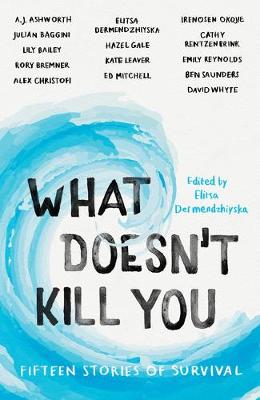
About What Doesn’t Kill You: Fifteen Stories of Survival (Unbound)
An explorer spends a decade preparing for an expedition to the South Pole; what happens when you live for a goal, but once it’s been accomplished, you discover it’s not enough? A successful broadcast journalist ends up broke, drunk and sleeping rough; what makes alcohol so hard to resist despite its ruinous consequences? A teenage girl tries to disappear by starving herself; what is this force that compels so many women to reduce their size so drastically?
In this essay collection, writers share the struggles that have shaped their lives – loss, depression, addiction, anxiety, trauma, identity and others. But as they take you on a journey to the darkest recesses of their mind, the authors grapple with challenges that haunt us all.
Edited by writer Elitsa Dermendzhiyska, What Doesn’t Kill You brings together candid, moving and, at times, humorous stories of struggle, survival and hope by the likes of Irenosen Okojie, Cathy Renzenbrink, Alex Christofi, Julian Baggini and Rory Bremner.
Lucy Writers would like to express their sincerest heartfelt thanks to the inimitable Irenosen Okojie for allowing us to publish a preview of her work, ‘Three Wise Women’.
Our express thanks also go to Elitsa Dermendzhiyska for allowing us to publish this piece from her exciting collection of essays What Doesn’t Kill You, to our current artist Sara Rivers and to Chris and Cathy Tutaev, at Tutaev Design, for their continued support in the design and development of the site at this time.
Image credits: Feature & article illustrations by Sara Rivers (2020); photograph of Irenosen Okojie by David Kwaw Mensah.


