

In this beautifully meditative essay, Emma Jones reflects on Ithell Colquhoun’s painting, Scylla, the artist’s links to British Surrealism and how seeing the body as landscape takes us beyond our narrow borders into new realms of personal and collective freedom.
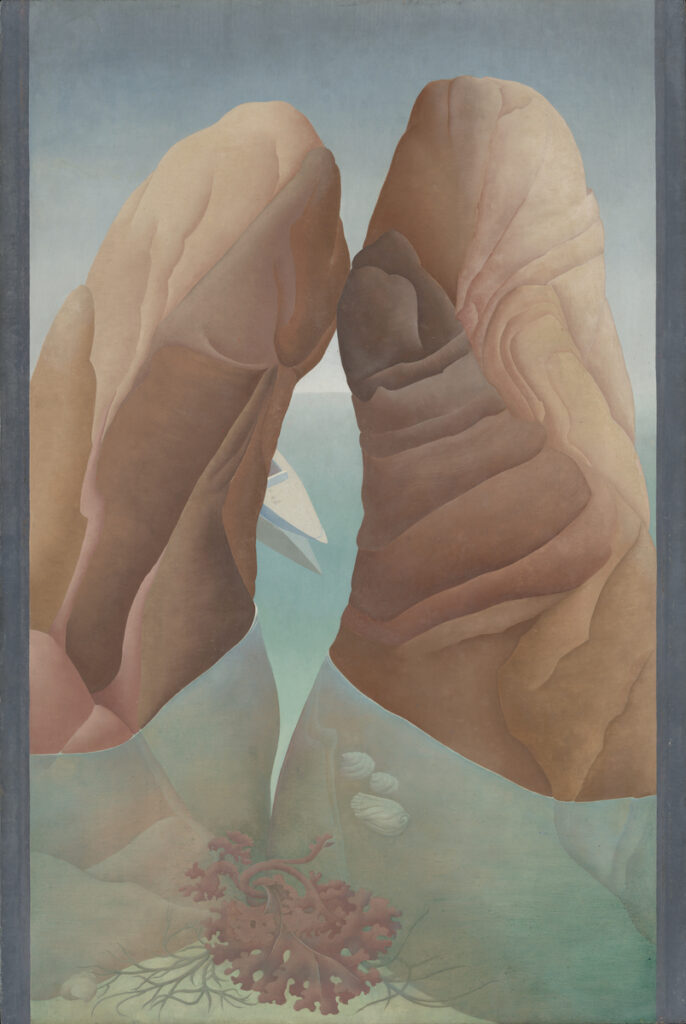
I’ve seen other paintings of women in baths, but it’s Ithell Colquhoun’s Scylla (1938) that returns to me as I lie here, the water around me cooling. In the painting, Colquhoun reimagines her own body as it appears to her looking down at her legs in a bathtub. Her peaking knees and thick thighs become fleshy cliffs. Under the water, where the two cliffs meet, wet and heavy pubic hair is instead blooming seaweed, feathering outwards. On one rock thigh, a small collection of white shells is suckered to the skin. Scylla is likely titled after the monster who, in Greek mythology, lured sailors to their watery death in the narrow passage between two cliffs. Just nosing into the central space of the painting is the pointed bow of a white boat. Despite the still water, the suggestion is that it’ll be crushed or thrown against the rocks.
Colquhoun supposes herself as both body and landscape, both in the bath and outside of it. For her, the bath is a space to connect the body to something larger that sits outside of itself. Part of the reason Scylla appeals is the fact that, when I am in the bath, I am also aware of being-in-between. As I step in, there’s a reddening. My underneath body shifts slightly, and is no longer quite connected to its outer self. It is refracted, off-kilter. I am aware of the vibration of water caused by my heartbeat, a tiny rippling. The light plays tricks on how I see myself. Everything is held in place but only tenuously, it is likely to fragment.
At the time of painting Scylla, the artist and occultist Ithell Colquhoun was embedded within the British Surrealist movement. An encounter with the works shown in the 1936 London International Surrealism Exhibition, an exhibition of her works alongside Roland Penrose in 1939 and a gathering with like-minded surrealists in Western France the same year, all had an impact. It was, however, the otherworldly aspects of the movement that impressed most heavily. Notably, Colquhoun’s use of automatism, a technique used to penetrate the symbols of the unconscious mind, would continue throughout her career. While her official relationship with the movement broke down after 1942, the Surrealist notion of the double image, which is suggested by the existence of both body and landscape in Scylla, is also seen elsewhere. In her paintings and drawings of the natural world, Colquhoun suggests a different type of doubling, one that focuses on the multiple realities within a single representation.
In parallel to her involvement with the surrealists Colquhoun was also developing her own magical thinking, aligning the energies found in the body with the magnetic currents of the land. Painting and sketching her immediate surroundings, often around the coast of Cornwall, she kept returning to bodies of water. Her drawing Rock Pool (c.1947) is a collection of loose automatic linework that converges, crosses and intersects, and has later been returned to and given depth. Shading provides a sense of shape and the weight of stone. In the centre a dark black inky pool is wrinkled with lines, perhaps seaweed, perhaps the surface movement of the water. Small markings on the rocks are indicative of algae, or simply the stippled surface of the rock itself. By its very nature, two representations exist within the rockpool. It is a single surface with a fracture or hole that contains multitudes. It is a type of gateway to another world. However, such existence is only temporary. At the bidding of the tide, these small pools are a liminal space. After the water recedes all that will be left is an empty depression, and a memory of all that second world can offer.
I don’t know where Colquhoun’s bathtub was, but the bath I’m lying in, its water now tepid, now puckering the skin, is in the Lake District, just outside of Grasmere. Through the window the hills are visible. From here, so far away, I can only grasp at the texture of them, the fissures caused by the grey rock pushing through the earth. Earlier, I walked through these hills, through the wooden gates and sheep-filled fields, up the well-trod path to Easedale Tarn. All around, the ground was thick with low lying bracken and tufting grass. At the basin, I found the water clear but reflecting the burnt brown of the rocks beneath. I stripped and stepped into that water and felt its cold rush. There’s a small sliver of waterfall tumbling down the valley. It is not quite true to say that I am lying down in the bath like Colquhoun was. I am not sitting up with raised knees, but curled roundly like a stone. Most of my body is submerged, but there are small islands of skin where there’s a quiet lapping. A circular patch of my left thigh is uncovered. The tips of my hair are stuck to my collarbone. I’m sinking deeper, reminded of the stones on the shore of the tarn that the water reaches but does not swallow whole.
Such an experience of the relationship between bath, body and landscape stands in stark contrast to the other paintings of women in baths that I’ve previously seen. There are two other examples that, like Scylla, are in Tate’s collection, and that you could come across walking through the galleries. Pierre Bonnard’s portrait of his wife, Marthe, in Baignoire (Le Bain) (The Bath, 1925). Marthe, in her mid-fifties at the time of being painted, deathly pale as the white porcelain that holds her, is imagined by Bonnard as her younger self. The perspective is close and angular, the bath fills almost the whole frame. The steep curve of it is more suggestive of a burial, a space of utter stillness, a turning away from the world. Or, elsewhere, the Pre-Raphaelite painting Ophelia (1851-2) by John Everett Millais. Although based on Ophelia’s drowning in Shakespeare’s Hamlet, it was created thanks to the model Elizabeth Siddal posing in a bath over a period of four months. Millais visited a river in Ewell, Surrey, multiple times to paint the landscape for Ophelia, while Siddal’s body was added later. Perhaps it is an awareness of construction that leads, for me, to this painting seeming so static. The water is glassy rather than flowing. Ophelia looks stuck in it. Only her head, hands and wrists are visible, everything else consumed by both billowing dress and the water slowly turning it weighty. It’s desperate, really. The body is looked at from outside, and is held so still as if to appear lifeless.
But the body underwater isn’t still, she moves. Colquhoun takes her own image and turns it into something new, something active. She chooses to define herself. She thinks of the body surpassing itself and its immediate borders and becomes part of a landscape. In a letter from 1977, Colquhoun writes that Scylla was borne out of ‘what I could see of myself in the bath’. She saw cliffs and a channel, a homeric myth, but also the potential to cause destruction. It is that boat I keep returning to, so small against the cliffs and attempting its futile passage. According to Colquhoun’s ex-husband, Toni del Renzio, the work is part of a series of paintings inspired by an affair she had with a fisherman while on holiday in Corsica. Read with this biographical information in mind, the passage is charged with sexual energy, one that is decidedly feminine in its powerful eroticism. If the boat is phallic, then its small, bobbing impotence seems lacking compared to the strength and steadfastness of the cliffs. In my mind, the view is a conscious alliance with the divine feminine, even if this means a recognition and acceptance of the monstrous within the self.
Colquhoun was 32 when she painted Scylla, the same age that I am now. My relationship with my own body is complex, guided by self-doubt and obsession, and a gulf of distance between what it is and how I think it should be. To put it bluntly, there are times when I dislike the way that I look, which builds to such an extent that it makes it hard to get dressed and leave the house. When my own body feels at odds with itself, when I am afraid of being looked at, I try my best to move beyond the skin of myself and into the landscape. Stepping away or slipping under to the point of embracing unfamiliarity is a process of self-othering that allows me to connect with something larger than myself. When I am at my most self-conscious, my most unsure, these connections bolster me, remind me that my body is not just my own. And while sometimes I may only be brave enough to lie in the bath, it is a sense of belonging that washes over me, that dissolves me into the surroundings outside of my window.
There exists in Colquhoun’s work an invitation to attempt to embody that which exists beyond ourselves. Beyond the immediacies of self-care, such transgressions have wider implications. At a time when the fear and desperation of the climate emergency weighs upon us, both individually and collectively, the crossing over of fixed boundaries allows for an empathetic relationship with the non-human. Colquhoun suggests a way of seeing that rejects an inward turn and, instead, opens a gateway to a world that is a part of us too, should we choose to step over the threshold. Climbing out of the bathtub, picking my way across the shoreline from the depths of Easedale Tarn, I fumble my clothes back onto unfamiliar skin.
See Ithell Colquhoun’s Scylla (1938) at Tate Britain and find out more information about the painting here.
About Emma Jones
Emma Jones is a freelance art and non-fiction writer who is interested in the slippery form of the essay. Her art writing is mainly focused on photography. Recent writing credits include contributions to the book publication Photography: A Feminist History (2021) and the magazine L’essenzial Studio Journal V.4 (2022). Contact her on twitter: @perceptivehow
This piece was commissioned for our mini-series, Our Body’s Bodies
Everything is written on the body – but what does it mean to write about our bodies in the era of Covid-19? And is it possible to write about bodily experiences in the face of such pervasive and continued violence? Using different modes of writing and art making, Lucy Writers presents a miniseries featuring creatives whose work, ideas and personal experiences explore embodiment, bodily agency, the liberties imposed on, taken with, or found in our bodies. Beginning from a position of multiplicity and intersectionality, our contributors explore their body’s bodies and the languages – visual, linguistic, aural, performance-based and otherwise – that have enabled them to express and reclaim different forms of (dis)embodiment in the last two years. Starting with the body(s), but going outwards to connect with encounters that (dis)connect us from the bodies of others – illness, accessibility, gender, race and class, work, and political and legal precedents and movements – Our Body’s Bodies seeks to shine a light on what we corporally share, as much as what we individually hold true to.
Bringing together work by artistic duo Kathryn Cutler-MacKenzie and Ben Caro, poet Emily Swettenham, writer and poet Elodie Rose Barnes, author Ayo Deforge, writer and researcher Georgia Poplett, writer and poet Rojbîn Arjen Yigit, writer and researcher Hannah Hutchings-Georgiou and many others, as well as interviews with and reviews of work by Elinor Cleghorn, Lucia Osbourne Crowley and Alice Hattrick, Lucy Writers brings together individual stories of what our bodies have endured, carried, suffered, surpassed, craved and even enjoyed, because…these bodies are my body; we are a many bodied being. Touch this one, you move them all, our bodies’ body.
We also welcome pitches and contributions from writers, artists, film-makers and researchers outside of the Lucy Writers’ community. Please inquire for book reviews too.
For submissions relating to trans and non-binary culture email dytorfrankie@gmail.com
For poetry submissions email elodierosebarnes@gmail.com
For reviews, prose submissions, artwork and general inquiries email hannah.hutchings-georgiou.16@ucl.ac.uk
Submissions are open on a rolling basis. For the full Call Out, click here.
Read the series so far here.
Feature image of Ithell Colquhoun, c.1930s.


