
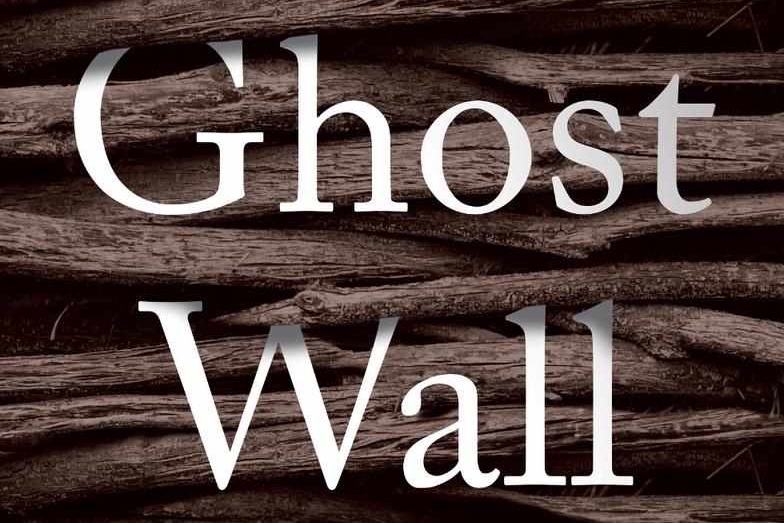
An Iron Age re-enactment in Northumberland takes a brutal turn in Sarah Moss’ Ghost Wall. With parallels to Brexit Britain, Moss’ slender novel is a coming-of-age tale with a twist.
I hadn’t read any Sarah Moss before, though it was a name I’d heard, spoken about reverentially. I’d seen her books in the piles of staff picks in bookshops or photographed and captioned with lavish praise on the Instagram accounts of literary types I followed. I had read her contribution to the April edition of the Tiny Letter Women Cook For Me and marvelled at how exquisitely she wrote about the simple act of baking bread. So I came to Ghost Wall with high expectations. It didn’t disappoint.
Ghost Wall is a slim slip of a book, less than 150 pages, but it contains so much depth within. It opens thousands of years ago in Iron Age Britain with a brief but haunting description of a young woman’s final minutes before she is killed in ritual sacrifice. In a few paragraphs it evokes so clearly the animal fear she is feeling, her isolation from her family and fellow villagers, marked out as she is to die. A turn of the page and the reader is snapped back to late 20th century Northumberland and an Iron Age re-enactment camp where working class teenager Silvie is spending the summer with her overbearing, Ancient Britain obsessed father, passive and fearful mother, a somewhat pompous archaeology professor and three of his students. We stay in the 20th century for the rest of the novel which takes place over the course of a week but those opening moments linger with the reader throughout, and indeed are actively recalled at points, building into a terrible climax.
Ghost Wall is about the past and the present and the interplay between the two. We are given a sense of how the boundaries between them are porous, how what has gone before bleeds into what is happening now and begins to influence it. Bill, Silvie’s father, takes the re-enactment more seriously than anyone else in the group. Whilst the students sleep in nylon tents and undertake covert trips to the local Spar supermarket, and the Professor wears tennis socks to avoid getting blisters from his moccasins, Bill is almost cultishly dedicated to trying to capture a lost past which, in his eyes, is purer and more truthful than the era he inhabits. The present day for Bill is full of ‘foreigners coming over here, telling us what to think’ when what he wants is ‘his own ancestry…a lineage, a claim on something.’ This idolisation of a past Britain as one that is superior to the Britain we inhabit now, and a slavish commitment to recreating that past by any means necessary, will to many readers have chilling parallels with 2019 Brexit Britain.
A fascination with a more hierarchical and brutal past also serves to validate Bill’s views about the proper role of women (submissive, subservient, chaste), and his affiliation with violence and death. He visits museums because ‘he likes dead things’; he takes pleasure in hunting and skinning rabbits, in demonstrating his perceived strength over the male students who are made queasy by witnessing such a sight. His violence towards his wife and daughter, constantly alluded to, and at one point vividly depicted, is an undercurrent of stifling threat throughout. There is a particularly uncomfortable scene recalled midway through where, showing Silvie a book about bog sacrifices, he points out on his daughter’s body all the places where the victim had been struck and cut. This might be harmless in any other context, but, with the knowledge already of his abuse, the scene has an undeniably sinister quality to it. Readers will later understand they were right to feel uneasy as the book canters towards its conclusion and we realise just how blurred the boundaries between the brutal, murderous past and the present day have become to some of those in the camp. In contrast, Molly, the female student, has been drawn to the re-enactment because she ‘liked the idea you could learn from doing things, that it’s not all books and speculation’. Rather than having artefacts sitting in museums, the recreation of baskets using traditional materials and techniques appeals to her: ‘I’d like to make things be alive again’.

Moss has said that Ghost Wall is “a book about edges and surfaces and boundaries” and this sense of physical place and our position within it as humans is captured expertly by the writer. The Northumberland landscape, its woods, streams, moorland and beaches, the plants growing on it and the creatures that inhabit it, is almost a character in itself. Moss conjures the uncomfortable heat of the summer days, ‘shimmering and windless’, the way that nature can be both bountiful but also unyielding. We feel the struggle of those on the camp, made soft by the convenience of supermarkets and ready meals, as they try to forage enough roots and leaves and catch enough fish and small animals to feed themselves, in contrast to those ancient inhabitants who would have known the land intimately.
Edges and surfaces and boundaries are not always geographical ones, and this book also wonderfully depicts those experienced by Silvie. Moss says that ‘the reader needs to be in Silvie’s skin but also always aware of skin’, and this is meticulously achieved. We feel acutely Silvie’s discomfort in her own body, both in the immediate sense – the rough, itchy tunic she wears – and in the more existential sense, through her interactions with the slightly older, more worldly, significantly more privileged students. Although of them all, it is Silvie who best understands the physical landscape and how to survive in it, and has her own version of self-assurance because of this. We feel keenly her desperate longing for freedom as she hears tales of the students’ interrailing adventures, and, having witnessed confident Molly strip to purple lacey underwear and swim in the sea, as she imagines all of the jewel bright colours she will herself one day buy when she ‘grow[s] up’ and ‘get[s] away’. We experience first-hand Silvie’s own sexuality growing tentatively over the course of the week, largely through her developing friendship with Molly who she watches in fascination and yearns at times to touch. It is Molly who shows Silvie what love and kindness truly is, who calls out the violence inflicted by Silvie’s father, even as Silvie tries to justify it in the way the abused can sometimes do. Silvie’s ardent ‘people don’t bother to hurt what they don’t love’, is countered by Molly’s frank and simple rebuttal ‘It’s not OK for someone to hit you.’
Ultimately it is this aspect of the novel that lingered with me longest after I had turned the final page. Not the way the past haunts us, and we it. Not the complicated, at times intensely problematic, interactions between those who have power, physical or otherwise, and those who don’t, between those who are privileged and those who aren’t. Not humans’ capacity for brutality and violence. But rather our remarkable capacity for love and kindness, despite it all.
Sarah Moss’ Ghost Wall is published by Granta and is available to purchase online and in all good bookshops around the UK now. Click here for more information about Moss and her work. You can read an extract from Ghost Wall here.


