
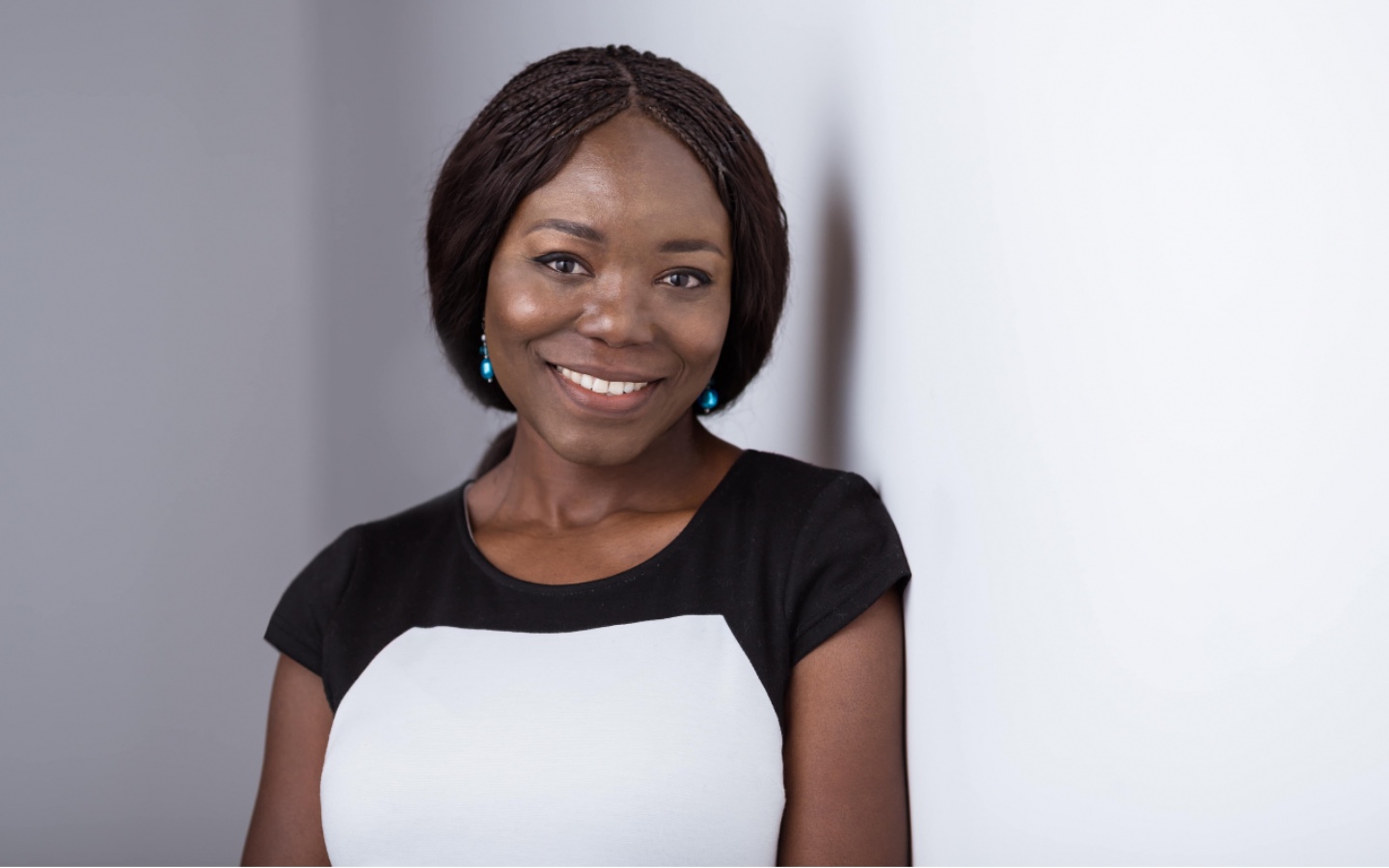
Emma Korantema talks to novelist Buki Papillon about her stunning debut, An Ordinary Wonder, her literary inspirations, studying law and getting over rejection as a writer.
On a cold Thursday evening in London, and an assuredly more crisp spring afternoon in Boston, Buki Papillon sits down with me in the virtual equivalent of a cosy, condensed coffee shop – my Zoom meeting room – feeling admittedly “excited and nervous” about the release of her debut novel, An Ordinary Wonder, a week to the day from launch.
The usual genial neutrality of first time meetings is sharply usurped by Buki’s enthusiasm to open up about her forthcoming coming of age story, in which we see an intersex twin, Oto, face the pressures of being forced to live as boy, despite feeling deep down that they are truly a girl. An Ordinary Wonder beautifully explores the concepts of self, family, friendship, and love, taking us on an intimate journey with Oto, through these areas with themselves and the world(s) around them.
In the hour that follows, Buki and I discuss her journey into, through, and back to writing, as well as her inspirations for An Ordinary Wonder, her experience of the publishing process, her advice to other writers, and her hopes for the future.
I start by extending my heartfelt compliments to her on an extraordinarily wonderful debut.
How do you feel about An Ordinary Wonder coming out?
Excited… nervous… I don’t know what to expect. This is my first rodeo. My first book!
Is it the debut you always imagined writing?
At the beginning, I had this idea of what the book was going to be and honestly, what it turned out to be at the end was what I had wanted at the beginning, but didn’t know at the time. That’s the weird thing about writing, right? I think as writers, we can usually see the end product, but the process of actually getting it there can be so messy and unknown.
I actually got to a point with this novel, where I threw out maybe seventy percent of everything I’d written and started over.
At what stage was this?
A lot later on. I was having problems with the structure and the only way I could make it work was to throw out a whole lot and start again from the beginning. I cut everything up onto pieces of paper and had to physically rearrange it all on the floor.
I recently saw this technique used on I May Destroy You. The main character – also an author – uses this method. Have you seen it?
I haven’t, but it’s on my list!
What did that feel like? Was it a tough decision to make?
Yes. It was hard because you always think you’re there and then you suddenly realise you actually aren’t quite there yet. It’s like being in a boxing ring when you’ve been knocked out and you can hear the referee counting down, so you’re trying to find that little remaining something inside you to get up and go at it again. That’s how it sometimes felt!
Papillon expands on the process of piecing An Ordinary Wonder together later in our conversation, but first, we dissect and piece together her journey as a writer so far.
Oral Traditions
As a child, what did you want to do when you grew up?
I wanted to be a ballet dancer![laughs]
I had this neighbour who had the same dress as me, and we’d practice “ballet”… But I think deep down, I wanted to be someone who told stories, I just didn’t have the courage to say so. I didn’t understand it entirely. When you’re growing up in Nigeria, you don’t say you want to be a writer. You say you want to be a doctor, or a lawyer, or an engineer.
Growing up, I always loved literature. My literature teachers were my favourite people on earth! When I was twelve, one leant me a thesaurus, and it was just amazing. I used it to write a school poem.
A debut isn’t always the first book that an author might have written. When did you write your first book and how old were you?
When I was eight, I got my hands on a copy of the Finn Family Moomintroll – a really fun series written by a Swedish author [Tove Jansson]. After reading it, I decided that I wanted to write my own Moomintroll adventures, and so I did. I always joke that I wrote my first book completely for myself and not because I thought anyone was going to read it.
That book later vanished because we moved quite a lot when I was a kid. I’m really sad because I would have loved to now read what I wrote! I think I’m actually going to go back to read my Moomintroll books to remind me of the fantastical creatures…
When did you start telling stories to other people?
In secondary school. Whenever it was a really hot night at boarding school in Nigeria, we’d pull our mattresses out onto the quadrangle, under the moonlight, and tell stories. I was often the designated storyteller. It was lovely. After boarding school, I put aside writing for a long time, went to university, and studied Law. There are so many of us Lawyers that turn into writers, it’s almost like: Do you want to be a writer? Then study Law!
All that essay writing… It’s probably quite a good degree for a writer?
Yes, it is. It’s just an expensive way to become a writer!
All aboard the Alternative Career Train: The Journey to An Ordinary Wonder
It wasn’t until I moved to the U.S. with my husband for his post doc that I decided to officially start writing again. Because I’d accompanied him to Stanford, I was able to apply especially for a small grant called the Spouse Education Fund. It was a small amount, but for the first time, someone gave me money to write. It was unbelievable to me that someone was actually saying: “Here is a little bit of money, go and write”. All my life it had felt like: Oh that frivolous thing that you have to put aside and do maybe one day.
I also took an online writing class, and that was the first time that other people read my work. They were so complimentary. One person even said: “I missed my train stop reading your story”. I was so shocked.
After this, because of the work restrictions attached to my visa at the time, my only options were Law school or more writing. The grown up, stern voice in my head said: “You should go and be a lawyer, so you can make money…”, but at the same time, I knew Law school would be a massive expense if we weren’t going to stay in the U.S. long term, so I decided to go for it and get my MFA at Lesley University.
I studied for two years and I loved it. Writers who had published books were telling me how to do what they had done. This was where I started writing for real.
When I finished my MFA, I was finally able to work and earn money. I knew I needed a job that would allow me to be my whole self at work, yet still hold onto enough of myself to write, so I went through this book called What Color is your Parachute? to figure out what I could do. I’ve told everyone I’ve ever met: If you’re worried, or you’re trying to figure out yourself, go and get this book! It recommended that I become a massage therapist, a psychotherapist, or a therapist of any sort – just someone who takes care of other people. Of the three, massage therapy took the least time (one year) and cost investment to qualify and it sounded good to me, so off I went.
I put aside writing again for that whole year to focus on getting my license and establishing my massage therapy career. Only after all of that, did I come back to writing again and focus on my novel. I started to write it in bits and pieces as the years went by, and while working.
So that’s the journey to An Ordinary Wonder! I think that’s a very long story…
It doesn’t seem like it could have been any shorter. All I can hear is the passion and the fact that you never left it, really. It sounded like it’s a long road but writing was always the goal. You also picked up a qualification on the way, so congrats! What gave you the idea for An Ordinary Wonder? Why did you want to tell this story?
It started as a little glimmer of an idea at the end of my MFA. During my MFA I wrote other things, but this idea steadily grew.
While I was reading and studying African – more specifically Nigerian – folklore, I heard a voice telling me the story very clearly, so I sat down and wrote as fast as I could, trying to figure out: Who is this? What are they trying to tell me? What is this about? It was only when I started to understand the depth and weight of what this story was about, that I realised: Okay, I need to do this properly, I need to tell this the right way.
I wanted to change the conversation, but at the same time reflect the realities of gender variance and what it means to be gender non-conforming in African societies, especially in Nigeria, and especially around intersex and LGBTQI+ identities altogether. While in other countries there has been progress around these issues, there are still many parts of the world where we need to do better and catch up.
I can’t speak on the present situation in Nigeria, but in Ghana very sadly, the president recently spoke out against LGBTQI+ rights. It’s great to see the issue as it is in West Africa addressed in such a culturally rich and representative way in An Ordinary Wonder, as opposed to being othered as a purely Western issue. Is this an issue you have had experience of or known somebody to have experience of?
Everything in An Ordinary Wonder is – well, not everything, but a good amount of what is in there – is informed by personal experience and other people’s experiences, however I’m not at liberty to say whose. So, yes, it all reflects reality. It can come across quite dark in many ways, it’s definitely not a fairytale.
You definitely tackle the tough issues.
I don’t think I have a choice, I think they find me.
Seeking Inspiration
What would you say inspires you most with your writing?
Reading!! Above all. I read voraciously. I read everything. Thrillers, romance, history, literary fiction, children’s fiction picture books. You name it, I read it.The only thing I don’t read is horror because I scare myself silly.
What is your favourite book?
One Hundred years of Solitude by Gabriel Garcia Marquez is my favourite book in the world. I’ve read it twice, and each time I feel like I’ve stepped into a dream. It is the closest to being awake while dreaming I’ve ever gotten while reading a book. There are no words for it.
It’s interesting you say that, because there are parts of your book – especially where Yeyemi visits Oto – that seem very lucid. That ‘dreaming while awake’ feeling is definitely what I got from those scenes. Was that your intention?
I definitely was very influenced by that, yes!
Publishing a Novel
What was one of the most surprising things you learned while creating An Ordinary Wonder?
For any writer, the rejections are unpleasant surprises. But you have to learn to live with, overcome, and accept them as part and parcel of the journey. That part of the publishing process was definitely not fun.
I received quite a few rejections of this novel at the beginning because of my writing. However, that’s also the thing with it not quite being there yet; sometimes people are kind enough to tell you, and at that point, the key is to not give up and to go back and revisit things.
The pleasant surprises have been just how excellent and unbelievably kind people have been. I didn’t know what to expect on this publishing journey, but the kindness that I have found from my publishers Dialogue Books – from the entire team – has been amazing.

Millie [Seaward] – who is the marketing person at Dialogue – is a sweetheart! It’s the first time I’ve ever called her that so I don’t know what she’ll make of it, but she is a sweetheart!
And my agent, Juliet. Boy, where do I start?! [BP Laughs]
She was able to just really look at An Ordinary Wonder, and between us both, we figured out the clarity of what things like the structure needed to be. She would then hang tight for as many rounds as I needed to go. She has had the patience of a real saint!
Sharmaine Lovegrove, my Editor, and the head of Dialogue Books – ugh, what a woman! She just gets it. She’s had this light touch throughout. She knew just how much to prod me, how much to ask for, and she did it in such a way that I could go back, think about things, and then bring my own way to fixing what she had suggested. Our back and forth was brilliant.
So I think that’s the thing that has surprised me; that I have just been really, really lucky to have had the kindest people around.
The Writing Process
What is your work schedule like when you’re writing?
I like working on several things at once – I’m usually working on about two or three books at any given time.
How long does it take you to write a book?
This one took a lot of years because it was really very much stop and start. In between, I’d also write other things that I’ve now put aside, so I now have a whole body of work I’m really raring to go with.
So there’s more to come?
I hope so!
What does your family think of your writing?
I think, like many families of writers, they’re a bit baffled. [BP laughs]
They’re being very supportive. My parents are in Nigeria, so are a little removed from the immediacy of what is happening out in the U.K. and U.S., but everyone is being really lovely – baffled, but lovely.
What do you like to do when you’re not writing?
I make beadwoven jewellery. I have a loom and weave these very tiny 1mm beads into all sorts of creations. I haven’t had a lot of time recently but I can’t wait to go back to my loom because it’s really zen. When I’m beadweaving, I’m really focused so it’s very calming.
I like to walk a lot as my form of exercise. I can just put on my headphones to walk around the neighbourhood and before I know it, I’ve walked miles.
I also do still life photography for fun, but haven’t shared that with anyone yet. Maybe one day!
Writing Advice
Do you have any suggestions to help new writers? Any advice you wish you had been given?
The main thing I would say is: Hang tight, do not stop, do not give up. Keep going when you get knocked down – as you inevitably will – because not everyone out there is kind, and sometimes people will hand you criticism that is so awful you might not want to get up for days, but allow yourself the time to feel whatever you feel, get better, get up and come back at it.
Yes, keep getting better. Study your craft – this is very important. Know the rules, so that you can break them.
Are there any particular rules that you think you break stylistically?
I think the structure of An Ordinary Wonder is unusual and breaks a few rules in that the first and second thirds go back and forth in time, and then the final third is forward only. There were some things that the reader needed to learn sooner rather than later, and if I had gone chronologically, that information would have come too late. However, you said you have a theory and I’m curious to hear it…!
In addition to seeding information, I thought you were intentionally creating the tension around Oto’s present self struggling with their past self to launch them into the future. For me, the non-committance of the story to temporality beautifully moves it along, while also highlighting the tensions inherent in a society that claims to be contemporary, but still operates very closely in line with the deftly interwoven tenets of past societies. This tension also seems to palpably dissipate as Oto – and the story – enters Part Two.
Yes, there’s definitely this tension around becoming!
What do you think makes a good story?
You have to believe in the story yourself. You can always tell when a writer isn’t being sincere.
One of my teachers (‘AJ’) from my MFA once said: “Every writer has five preoccupations and those five preoccupations will always show up no matter what they write”.
I’ve realised that one of my preoccupations is sibling rivalry. There’s always some form of sibling relationship in my stories. I’m the first of many siblings and we all love each other to bits. They are everything to me, But if you have siblings, you know how it is: there are times when you’re friends and other times when you’re not so friendly, but throughout life, you have each other’s back.
Issues around family always come up as well. Particularly, family relationships, the family unit and how it relates to the outside world, and how much of who a person is in the outside world is informed by their family of origin, their culture, and how they grew up.
The process of moving from one country to another also preoccupies me. That idea of figuring out your own niche while learning a new culture, perhaps finding yourself alone, and trying to fit in despite not really feeling like you’re part of what is going on around you, because it’s all so new.
As you have done!
Also, lush storytelling. For me, that’s the ability to use words to take me out of my here and now. You know that feeling when you open a book in a bookstore and before you know it, you’re already several pages in? When the writer immediately, from page 1, says: “Come over here, I’m going to take you somewhere you’ve never been before”. That is what makes a good story.
Have you published work before?
I’ve published a prose poem, called ‘Only Softly’ once online. It’s actually about encouragement, and exactly the advice I’ve given. I’ve also published a short story called ‘Scheherazade For Natasha’ online too, so I think a few people have read things I’ve written in the past. But for the most part, I’ve not done a lot of publishing.
I’ve written tons of stories but it required an investment of time and effort to keep sending them out, so at some point, I figured that what I really wanted to do was get a novel out in the world.
So even though I kept writing stories, I just wrote them and kept them. I just didn’t have that time and that energy to keep sending them out.
The Future
What are you working on at the moment?
I’m writing a few different genres, but mainly literary fiction.
Are your subsequent books coming soon or would you like to give them time to grow too?
It feels like when you’re waiting ages for a bus, and then one finally comes, and five others follow immediately. I feel like that’s how it’s going to be. I’ve been waiting so long to get to this point where I have a published book and so everything else is naturally going to go a lot faster. I’m hoping to have a few books out really soon.
It sounds like you’re ready to board all of the buses. Wishing you all the success!
An Ordinary Wonder is published by Dialogue Books and available to purchase online and in all good bookshops. Click her to follow Buki on Twitter and Instagram.
Feature image is of Buki Papillon, courtesy of Ryuji Suzuki. Lucy Writers and Emma Hanson would like to thank Buki Papillon and all at Dialogue Books for allowing us to publish this interview.


