Our BAROQUE guest editor, Frankie Dytor, experiences a rush of dizzying and disorientating pleasure when reading two of Cipher Press’ books of fiction, Jess Arndt’s Large Animals and Alison Rumfitt’s Tell Me I’m Worthless.
Anna Kate Blair talks to author Sara Jaffe about why Dryland is an anti-coming-out novel, writers who have influenced her work, being published by the Queer UK-based Independent publisher Cipher Press, leaning into the awkwardness of writing about adolescence, music and much more.
In Jayna Brown’s Black Utopias, Emma Korantema discovers that the speculative practices and philosophies of Black creatives destabilise current understandings of the ‘human’, ‘knowledge’ and ‘existence’, instead redefining them and envisaging futures past from the privileged position of the periphery.
Elodie Barnes talks to poet, translator, and writer, Priya Sarukkai Chabria, about her revisioning of Rabindranath Tagore’s Gitanjali, mystical poetry, transformation and translation, and writing as an act of devotion.
In this striking essay, Selin Genc reviews Ewa Majewska’s ‘Feminist Antifascism’, and considers Majewska’s inspirational arguments for a “flexible, inclusive and inventive” feminism in the context of recent events in Turkey.
Jade French, Suzanna Petot and Lottie Whalen of the interdisciplinary collective, Decorating Dissidence, discuss the recent Sophie Taeuber-Arp exhibition at Tate Modern, how dance informed Taeuber-Arp’s work and practise, and why she is relevant for us today.
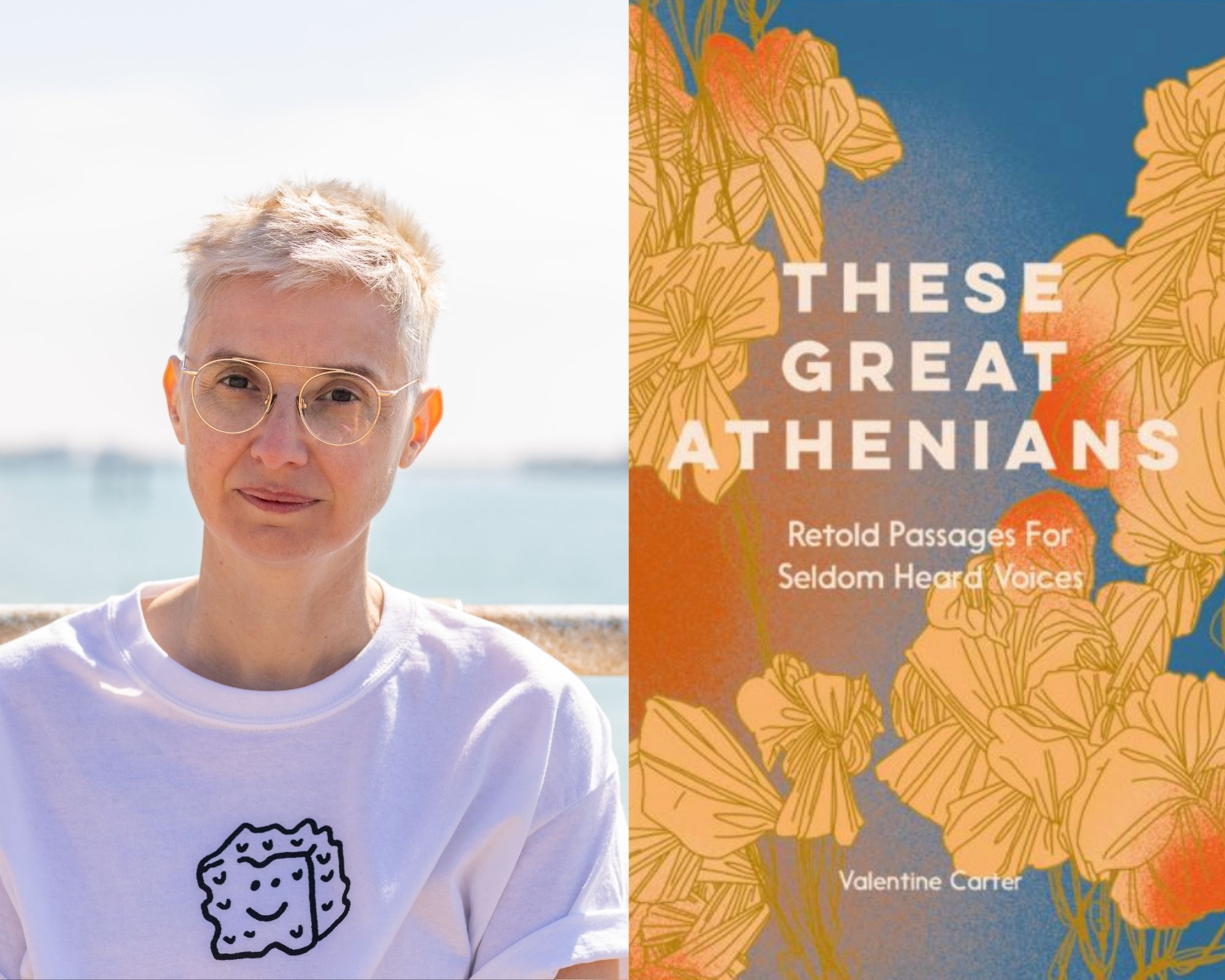
Georgia Poplett talks to author and visual artist, Valentine Carter, about their new book, These Great Athenians, the materiality of texts, breaking the genre of mythology as a non-binary writer, the sense of belonging that resides in myths, writing as a form of weaving and much more.
Tara Fatehi Irani’s outdoor performance, Mishandled Archive, dismantles and remantles the archive, embodies and rebodies memories, and, in its fragmentary state, gives us something to hold whilst holding us, writes So Mayer, in their stunning reflection on the artist’s work. With contributions from Elhum Shakerifar and Sam Fisher.
Frankie Dytor talks to writer, activist and curator, So Mayer, about their brilliant book, A Nazi Word for a Nazi Thing, writing as non-linear montage, actively creating the anarchive, the iconic figure of Magnus Hirschfeld, embodiment and more.
Emma Korantema reviews Julian Henriques’ 1998 musical film, Babymother, and considers the reality of single Black motherhood against its often prejudiced on- and off-screen representation.
Elodie Barnes talks to Emily Cooper about her debut collection Glass: poems which shift and reflect on the ideas of home as architectural space, home as memory space, permanence, impermanence, and the ‘ownership’ of stories.